
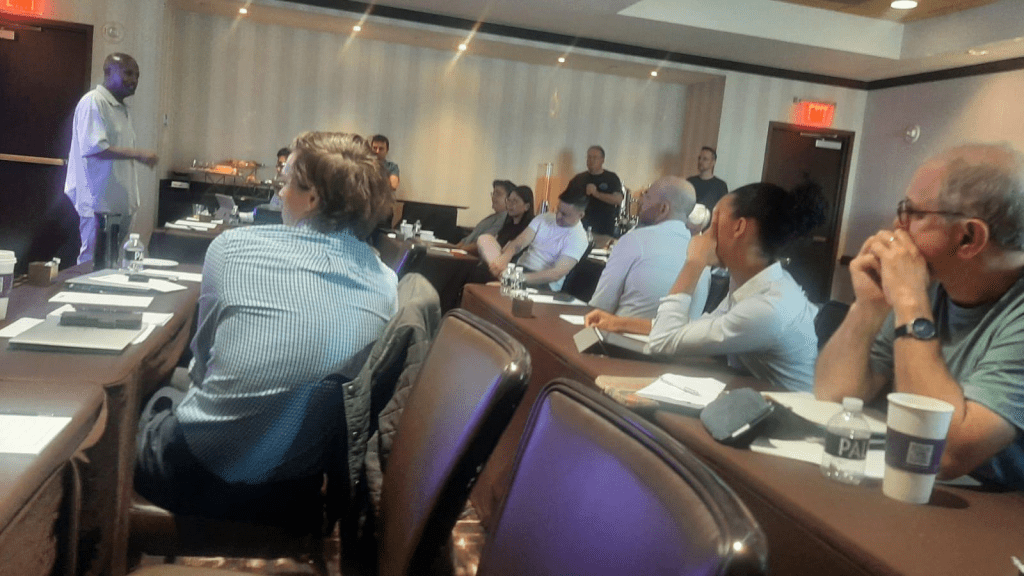
Presenting the Nexus of Genocide & Populist Leaders to TransResearch Consortium Scholars in Las Vegas, Nevada (Summer 2023)
Category: American Politics
Course Title: Voter Turnout
Course Description: This course explores the determinants of voter turnout in the United States. Keywords: socio-demographic determinants, institutional effects, historical trends. Students will study turnout data in Excel and SAS.
Learning Objectives:
1. Have knowledge of important theories and factors of voter turnout.
2. Statistical analysis of voter turnout data.
3. Research Data: Projected Voter Turnout Trends
Weekly Topics:
• Week 1: Understanding Voter Turnout
• Week 2: Historical Patterns of U.S. Voter Turnout
• Week 3: Socio-demographic Determinants of Turnout
• Week 4: Political Institutions and Voter Turnout
• Week 5: Using Excel to Analyze Voter Turnout Data
• Week 6: Voter Turnout: Local vs. National Elections
• Week 7: Case Studies: Get-Out-The-Vote Efforts
• Week 8: Introduction to Data Visualization and Excel Analysis
• Week 9: SAS Analysis Techniques
• Week 10: Workshop: Turnout Research Projects
• Week 11: The Policy Implications of Turnout Trends
• Week 12: Final Project Presentations.
Assessment:
Participation: 10%
Midterm Exam: 25%
Data Analysis Assignment (Excel/SAS): 30%
Final Research Project: 35%
________________________________________
Course Title: Vote Choice
Course Description: The course surveys the social aspects of politics, covering topics such as class, race, and gender; the course also explores the phenomenon of political engagement and disengagement as it addresses the politics of voting and elections. Students will use qualitative and quantitative methods to examine vote choice patterns.
Learning Objectives:
1. Characterize the determinants of voting behavior.
2. Explore the impacts of media and campaigns on vote choice.
3. Utilizing data and case study approaches to examining vote choice behavior.
Weekly Topics:
• Week 1: Vote Choice
• Week 2: The Ideology and Party Identification
• Week 3: Issue Voting & Retrospective Voting
• Week 4: Campaign Strategies and Their Impact
• Week 5: How Do We Collect Data on Vote Choice
• Week 6: The Media and Vote Choice
• Week 7: Case Studies: Recent U.S. Elections
• Week 8: Excel Analysis of Trends in Vote Choice
• Week 9: More Analytic Techniques with SAS
• Week 10: Workshop: Vote Choice Study Design
• Week 11: Presenting Findings Draft
• 12th Week: Research Project Final Presentation
Assessment:
Participation: 10%
Midterm Essay: 20%
Data Analysis Assignment (Excel/SAS) 30%.
Final Research Project: 40%
________________________________________
Categories: Comparative Politics
Democracy and Democratization
Course Description: This course looks at the processes and obstacles to democratization, particularly in light of populist leaders, ways of governance, ethnic federalism, and Revolutionary Democracy. Focus on Africa in general & Sub-Saharan Africa in particular.
Learning Objectives:
1. Theory Exercise — Compare Different Theories of Democratization
2. Test the effects of populist leaders and ethnic federalism and other forms of institutions on democracy.
3. Utilize both qualitative and quantitative methods to conduct analysis.
Weekly Topics:
• Week 1: What is Democracy? Concepts and Theories
• Week 2: Democratization: Processes and Obstacles
• Week 3: Populist Leaders and Their Effect on Democracy
• Week 4: Revolutionary Democracy: Case Studies
• Week 5: Ethnic Federalism: An Ethiopian Case Study
• Intro to Excel for Political Analysis (Week 6)
• Week 7: Understanding Democratic Transitions with Quantitative Data
• Week 8: Qualitative Analysis: Case Studies in Sub-Saharan Africa
• Week 9: Political Economy of Democracy in Africa
• Week 10: Hybrid Regimes and Democratic Backsliding
• Week 11: Workshop: Comparative Studies.
• Week 12: Final Project Presentations
Assessment:
Participation: 15%
Midterm Essay: 20%
Data Analysis Assignment (Excel) : 25%
Final Group Project: 40%
________________________________________
International Politics
Course: Genocide, Peace, and Conflict
Course Description: This course looks at the causes and consequences of genocide, interstate and civil wars and the role of multinational and interstate organizations in resolving conflict.
Learning Objectives:
1. For Genocide and Crimes against Humanity prevention, the following next steps are of utmost importance:
2. Consider the impact of international organizations in conflict resolution.
3. Identify trends in conflict behavior or performance using quantitative data.
Weekly Topics:
• Week 1: Introduction to Peace and Conflict Studies
• Week 2: Theories of War and Peace
• Week 3: Genocide: Definition and Causes
• Week 4: Case Studies: Rwanda and Tigray Genocides
• Week 5: Introduction to Excel for Conflict Data Analysis
• Week 6: Role of the UN and Other International Organizations
• Week 7: SAS Workshop: Analyzing Conflict Data
• Week 8: Civil Wars and Genocide: Patterns and Trends
• Week 9: Peacebuilding and Post-Conflict Reconstruction
• Week 10: Regional Focus: Africa
• Week 11: Policy Simulation: Preventing Lethal Social Conflicts Including Genocide
• Week 12: Final Research Presentations
Assessment:
Class Participation: 10%
Midterm Case Study Analysis: 25%
Project in Data Analysis (Excel/SAS): 30%
Final Policy Paper: 35%
________________________________________
Course Description: Quantitative Research Methods
Course Description: This class serves as an introduction to quantitative research methodologies, emphasizing Excel and SAS for data analytics. The study emphasizes hypothesis testing and analysis, statistical modeling, data visualization techniques, etc.
Learning Objectives:
1. Excel and SAS basics for working with quantitative data
2. You will learn principles of statistical inference and hypothesis testing.
3. Quantitative methods applied on real-world political science problems
Weekly Topics:
• Week 1: Quantitative Methods Overview
• Week 2: Research Design and Sampling Techniques
• Week 3: Purposes of Data Collection and Cleaning (Excel)
• Week 4: Summary stats
• Week 5: Inferential Statistics: Testing Hypotheses
• Week 6: Excel Data Visualizations
• Week 7: Getting Started with SAS
• Week 8: SAS Regression Analysis
• Week 9: Statistical models in SAS
• Week 10: Election: Political Science Research Applications
• Week 11: Workshop: Quantitative Results Interpretation
• Week 12: Final Research Project Presentations
Assessment:
Participation: 10%
Midterm Exam: 20%
Assignment 1 : Data Analysis — 30%
Final Research Project: 40%
________________________________________
Course Description: Qualitative Research Methods
Course Description: Students on this course will utilize these methods to examine political science topics.
Learning Objectives:
1. Learn about qualitative research design and methodology.
2. Content and thematic analysis.
3. Conduct qualitative research / present findings
Weekly Topics:
• Week 1: Introduction to Qualitative Research
• Week 2: Research Design in Qualitative Studies
• Week 3: Data Collection Techniques: Interviews and Archival Research
• Week 4: Content Analysis: Concepts and Applications
• Week 5: Case Studies: Methodology and Examples
• Week 6: Thematic Analysis: Coding and Interpretation
• Week 7: Combining Qualitative and Quantitative Approaches
• Week 8: Ethical Considerations in Qualitative Research
• Week 9: Writing and Presenting Qualitative Findings
• Week 10: Workshop: Analyzing Political Science Cases
• Week 11: Group Project Development
• Week 12: Final Research Presentations
Assessment:
Participation: 15%
Midterm Essay: 20%
Assignment 3: Qualitative Data Analysis (25%)
Final Research Project: 40%
Sample Syllabus: International Relations 101 Nuclear Proliferation

COURSE DESCRIPTION
This course examines and/or evaluates the far-reaching political, economic, and social implications of nuclear proliferation on states, nation-states, international regimes and organizations, global security, and non-state actors.
PURPOSE OF THE COURSE
To familiarize students to the pressing international relations issue of nuclear proliferation, which impact communities, state and non-state, regional and world-wide organizations. Students may benefit from this course if they are intending to pursue a career in diplomacy, economic development, human development, peace and security, and many other areas of international relations by representing their own country or the world. In the former case, students from the United States (US), for example, may pursue a career at the United States State Department, while in the latter case, students may pursue their career at the United Nations.
Sample of What We Will Learn
| Week 2 6/21—Tuesday Session 2 | Theories of Nuclear Proliferation: State Survival Theory; National Prestige Theory; and ‘Great Power’ Theory. Causes of Nuclear Proliferation: Insecurity & Access | Class discussion on theories of nuclear proliferation to identify countries who sought and/or are seeking nuclear weapons for reasons of insecurity and access Post the name of the countries on one of the boards of the class till the end of the semester Tentative due date: 6/28 Tuesday Entry 1: Please write, depict in picture, or on whatever medium and type you prefer to convey what you have learned in your journal Feedback by instructor after 24 hours of the receipt |
| Week 3 6/28—Tuesday Session 3 | The Pros and Cons of Nuclear Proliferation: Video clip of the debate between Sagan and Waltz: Sagan opposes nuclear proliferation while Walz supports it Non-proliferation Treaty | Class discussion Please write, depict in picture, or on whatever medium and type you prefer to convey what you think after watching the video clip and listened to the argument and counter argument regarding nuclear proliferation. Tentative due date: 7/5 Tuesday Feedback by instructor after 24 hours of the receipt Quiz 1: Check canvas, open note, open book, two trials, the best score is registered (5 points toward final) |
| Week 4 7/5—Tuesday Session 4 | Second Generation Nuclear Powers Guest Lecturer: Professor Jacek Kugler: Professor of World Politics and International Relations at Claremont Graduate University | Question and answer Session Discussion |
| Week 5 7/12—Tuesday Session 5 | Nuclear Deterrence: The Serious Problems with Nuclear Deterrence | Short Video Clip (8:27 minutes) on The Serious Problems of Nuclear Deterrence |
| Week 6 7/19—Tuesday Session 6 | Nuclear Weapons and the Early Cold War | Quiz 2: Check canvas, open note, open book, two trials, the best score is registered (5 points toward final) |
| Week 7 7/26—Tuesday Session 7 | Nuclear Weapons and the End of the Cold War | Entry 1: In your Journal, please write, depict in picture, or on whatever medium and type you prefer to convey what you have learned in your journal (10 points toward the final) Feedback by instructor after 24 hours of the receipt |
Please download the syllabus to acquaint yourself with the full list of what we will be learning about nuclear proliferation.
You can download the complete sample syllabus here
Sample Assignments and Rubrics
Individual Project 1: Please choose a format to write (about 250 words), speak (about 5 minutes), artfully depict (in about 2 pages) the major differences and similarities of the major theories of nuclear proliferation (5 points toward final grade) Tentative due date: 6/28 Tuesday
Individual Project 2: Please choose a country that is familiar to you to do research on whether the country you chose is signatory to the non-nuclear proliferation treaty or not to present to class in any format of your choice. You can write (about 250 words), speak (about 5 minutes), artfully depict (in about 2 pages) your findings to the class (5 points toward final grade) Tentative due date: 7/5 Tuesday
Individual Project 3: Please create a sharable file named “What I have learned about nuclear proliferation” both from the course and your own reading and researching (5 points toward final grade) Tentative due date: 8/9 Tuesday
Group Project 1: Please plan to debate in class on behalf of nuclear proliferation or nonnuclear proliferation (10 points toward final grade) Date: 8/16 Tuesday
Group Project 2: Please write a collaborative essay arguing against or in support of nuclear proliferation (in a 5 double-spaced pages) (10 points toward final grade) Tentative due date: 8/23 Tuesday
My Experience of Legacy Education
Back home in the northern part of Ethiopia called Tigray, I was home schooled by my grandfather of my mother’s side right after I start speaking coherently. He wanted me to become a deacon for he was an Orthodox Christian revered and respected by the community he served. My grandmother disagreed vehemently, and I start going to grade 1 at a nearby elementary school. I vividly remember my first day in class. My teacher with his stick pointing at the two hundred thirty-one Amharic alphabets asking his students to repeat the sound of each alphabet ‘ha hu ha heie hiy ho…’. I was the only one not repeating…and my teacher thought that I was not following the simple rule. My teacher politely asked me ‘if there was something wrong’. And I told him no there is nothing wrong…’why then you do not repeat after me’? To which I answered I have already learned the alphabet at home. ‘Okay then stand up and teach the alphabet’…which I did. He then took me to the director’s office to tell him that I did not belong in that class…’please sit him in Grade 2’…the director refused to agree with his appeal. Because I was too young to start Grade 2. That was a barrier that I and my likes faced at an early age that I have never thought about until now. Because the privileges that I enjoyed were a plenty to forget. I was privileged because my education was fully subsidized by the poor farmers of Ethiopia for whom I am still indebted for life…The poor farmers paid for my education while their own children stayed on the farm for life to become the next generation of farmers to keep the statuesque. I was aware of my privilege and the extent to which the farmers of Ethiopia and their children were marginalized and oppressed…I took part in a movement to change that, and we did…But here I am in America sensing a sort of similar injustice in education that I was aware of in Ethiopia. Injustice in educating youngsters in America is real; it is not imagined. Because the value of your house should not be the basis for the quality of schools built in your neighborhood. The fact that it is, is one central aspect of my journey that I will always bear in my mind as my experience of legacy education continues. Because chances are that I may end up teaching kids in college whose zip codes were the bases of the quality of education they had had at early age.
My Experience of Legacy Education
Back home in the northern part of Ethiopia called Tigray, I was home schooled by my grandfather of my mother’s side right after I start speaking coherently. He wanted me to become a deacon for he was an Orthodox Christian revered and respected by the community he served. My grandmother disagreed vehemently, and I start going to grade 1 at a nearby elementary school. I vividly remember my first day in class. My teacher with his stick pointing at the two hundred thirty-one Amharic alphabets asking his students to repeat the sound of each alphabet ‘ha hu ha heie hiy ho…’. I was the only one not repeating…and my teacher thought that I was not following the simple rule. My teacher politely asked me ‘if there was something wrong’. And I told him no there is nothing wrong…’why then you do not repeat after me’? To which I answered I have already learned the alphabet at home. ‘Okay then stand up and teach the alphabet’…which I did. He then took me to the director’s office to tell him that I did not belong in that class…’please sit him in Grade 2’…the director refused to agree with his appeal. Because I was too young to start Grade 2. That was a barrier that I and my likes faced at an early age that I have never thought about until now. Because the privileges that I enjoyed were a plenty to forget. I was privileged because my education was fully subsidized by the poor farmers of Ethiopia for whom I am still indebted for life…The poor farmers paid for my education while their own children stayed on the farm for life to become the next generation of farmers to keep the statuesque. I was aware of my privilege and the extent to which the farmers of Ethiopia and their children were marginalized and oppressed…I took part in a movement to change that, and we did…But here I am in America sensing a sort of similar injustice in education that I was aware of in Ethiopia. Injustice in educating youngsters in America is real; it is not imagined. Because the value of your house should not be the basis for the quality of schools built in your neighborhood. The fact that it is, is one central aspect of my journey that I will always bear in my mind as my experience of legacy education continues. Because chances are that I may end up teaching kids in college whose zip codes were the bases of the quality of education they had had at early age.
My Teaching Metaphor: We all are fish in one of the largest seas of our world.

The largest sea is a habitat to diverse fishes. I am an ethical educator fish inhabiting the same sea as you my students and/or colleagues. I am flexible, accommodating, understanding, helpful, and enthusiastic for I understand that the sea may not be a welcoming habitat for some or many of you my student fishes who are new.
We are all in the largest sea together: We both flourish if we see ourselves as fishes of assorted color, origin, size, and look, and also that we inhabit the same sea. The largest sea is a complex habitat which requires knowledge and expertise to understand. It is the environment where I and you my student fishes learn to adopt.
Our largest sea has many legacy systems of habitats. Some habitats are hostile to some fish kinds while other habitats are hospitable. Our fish social life is dependent on the hospitability or lack thereof of the sea habitat. And it is my responsibility as an ethical educator fish to continuously figure out the solutions by learning from other fishes like you my students or from fishes that are more experienced than I.
Global warming and damping of chemical products to our habitat is a detriment to our fish social lives. Because we as fishes of the largest sea have no control over humans. And it is here where my metaphor breaks down when it strictly applied to the lives of fishes. Fish have no control of humans and their own habitat. But humans do have some control not only about what they do but also about something that they have not experienced before. They have the ingenuity to synthesize a medicine for a new sickness. They can venture out of their habitat to reach out and march beyond what the eye can see. And hence humans should be clear-eyed enough to create an education system based on Equality, Diversity, and Inclusivity. I alongside you my students and those who are tasked to run our University System will do so albeit incrementally. With that in mind let us learn what nuclear proliferation is and the impact that it may have on our world at so many levels.
My Teaching Philosophy & How I See You My Students and/or Colleagues
The following is a snippet of my teaching philosophy and how I see you my students and/or colleagues.
My mission as a teacher-scholar is twofold: To be an active participant in the just movement to correct the unjust and unfair legacy education system and to empower students by guiding them to learn at their own pace by applying scientifically proven teaching strategies.
I have come to realize that even my own assumptions about teaching and learning are flawed and that I needed to self-correct my mission in life since I have the dream and hope to teach. I wanted to become a teacher when I was a little kid without knowing about ethical teaching. The why I teach question in me is answered beyond any doubt, prompting me to even want to become a teacher more so than I did. My mission as an ethical teacher is to empower those who are marginalized by no fault of their own.
My mission or goals are informed by several factors that I have become cognizant about. It is informed, firstly, by the microsystems of identities and experiences that my students are made of—some biological (skin color, height, age…etc.). Secondly, by their socio-economic status that impacts housing, moneyed interest, medical and legal services to mention the few amongst the many. Thirdly, my teaching mission or goal is informed by the fact that my students come to my class as microsystems of identities and experiences in race or ethnicity, language, sexual orientation, profession…etc.
To be inclusive and considerate of other countries on earth such as those in Africa is the most critically needed transformation in teaching International Relation. Alongside teaching goes research projects of international relations which often are done to ameliorate conflict in any issue concerning countries in Europe more so than in any other countries in Africa.
My mission to make international relations a subject matter that covers countries of the world fairly is important for without it my students would not see the community that they are part of. The implications of going with the legacy education system of teaching less about Africa and other continents relative to Europe and North America are far-reaching. Students of international relations of North America and European origin, to say the least, may face impediments working as a diplomat or as an international business broker in Africa.
I approach teaching as a community affair that requires Complex Adaptive Response. That is to say that I as an aspiring ethical educator should be cognizant of my habitats or places of multiple belongings (cultures, religions, geographies, race, and etc.) the influences of which I may not be fully aware of. And by that I will design and facilitate learning in a way to avoid the Chimamanda Adichie’s notion of the danger of the single story.
Diversity Statement
To be cognizant, accepting, and embracing of the multitudinous of my student body in terms of their history, culture, tradition, language, religion, geography…etc. To be an active participant in dismantling barriers and constructing strong lasting bridges of oneness. To accommodate all my students by opening the space, environment, and/or habitat of the classroom to create a real sense of community. To take part in a movement or work that vies for justice that removes inequality.
Diversity in education can be the different lived education experience that my students have had. They might not have the space, habitat, or environment of schooling to grow and the socio-economic condition that are suitable to better learning outcome—while they are treated differently in facing the law, getting treatment, and education.
My mission to make international relations a subject matter that covers countries of the world fairly is important for without it my students would not see the community that they are part of. The implications of going with the legacy education system of teaching less about Africa and other continents relative to Europe and North America are far-reaching. Students of international relations of North America and European origin may face impediments working as a diplomat or as an international business broker.
My learning experience was shaped by the unjust and unfair legacy education system of Ethiopia. I had no idea about the legacy education system of other countries. To date, however, I have started to learn increasingly about the legacy education system of the richest and most powerful country in the world—the U.S.A. As a result, my perspective about the education system, administrators, teachers, and students has widened in ways that I have never imagined before. I have learned that the complexity of the legacy education system requires a complex adaptive response. And hence, unlike any other time in my learning experience, I see myself becoming an advocate for just and equitable education to all who need it all over the world. And by virtue of knowing a bit or more about the legacy education systems of two countries (Ethiopia and the U.S.A.), I have developed a worldwide-centered vision of fair and just education system. For that reason, my vision is to be an ethical teacher for all in the world who want to learn about international relations, peace and conflict, democracy and democratization, and international political economy. My mission is to find ways of internationalizing my lectures by utilizing modern digital tools. To do so, I will design a collaborative work with other scholars in other countries who share my vision and mission of educating those who want to learn.
Purposeful Vision – a sense of purpose in the future. This takes imagination together with goal-orientation. First, to be able to envision what might be and then to make that into a concrete goal or purpose and not just a wishful dream.
Effort Struggle – a striving toward the vision. There is a pathway to travel that is often not plain sailing. There might be setbacks and difficulties, things still unknown that must be discovered, learning along the way to move toward the end goal of our vision.
Meaningfulness – the purpose is meaningful to the individual. The energy and motivation to move toward our vision comes from finding a meaningful reason and connection to what we are striving for, especially as we encounter new and unknown things we must learn and setbacks we must navigate. That is, the purpose and vision is something we believe in and want to strive for whether for personal or pragmatic reasons.
What specific strategies do I use to ensure all voices are invited, honored, and supported in my curricula materials and class engagement? Open discussion—the kind utilized by Professor Mazur. Anonymous voting and remarks. Posing questions to the entire class instead of singling out a student.
How do I engage with DEI work beyond the classroom at the campus level? How do I engage formally and informally with campus resources and initiatives that support DEI. In what ways am I an ally to students and an advocate for greater inclusion and equity on campus? I can be an ally with my students, especially if their concern is emanating from the unjust and unfair legacy education system by offering my help and taking an active role as needed—be it in the school and outside of the school.
How do I engage with DEI work and scholarship in scholarly and professional disciplinary spaces? By engaging all of my peers in the discipline to convey the need for a fair and just education system by basing my remark on scientifically proven research.
What are some issues with respect to DEI in my discipline with regard to research/scholarship and in teaching? Issues of not addressing the pressing international relations problems inundating particularly countries in Africa.
As an educator in my discipline, how do I keep myself informed of conversations about and professional development in ethical teaching innovations? By keep learning the scientific studies of education and learning how to teach.
As a scholar and researcher, how do I engage DEI principles in methods and in representing broader populations and ways of knowing and articulating scholarship? By keep learning about people and countries who are internationally marginalized by virtue of their skin color, geography, culture, tradition, religion, language, and …etc.—to research, teach, research, teach cycle in hope to install interest in my peers who have been otherwise lukewarm about such a people and country.
Americans with Disabilities Act (ADA)
Reasonable accommodation will be provided for any student who is registered with the Office of Students with Disabilities and requests needed accommodation. For more information visit the Office for Students with Disabilities home page.
 Dr. Adal Isaw (PhD International Politics / Political Science)